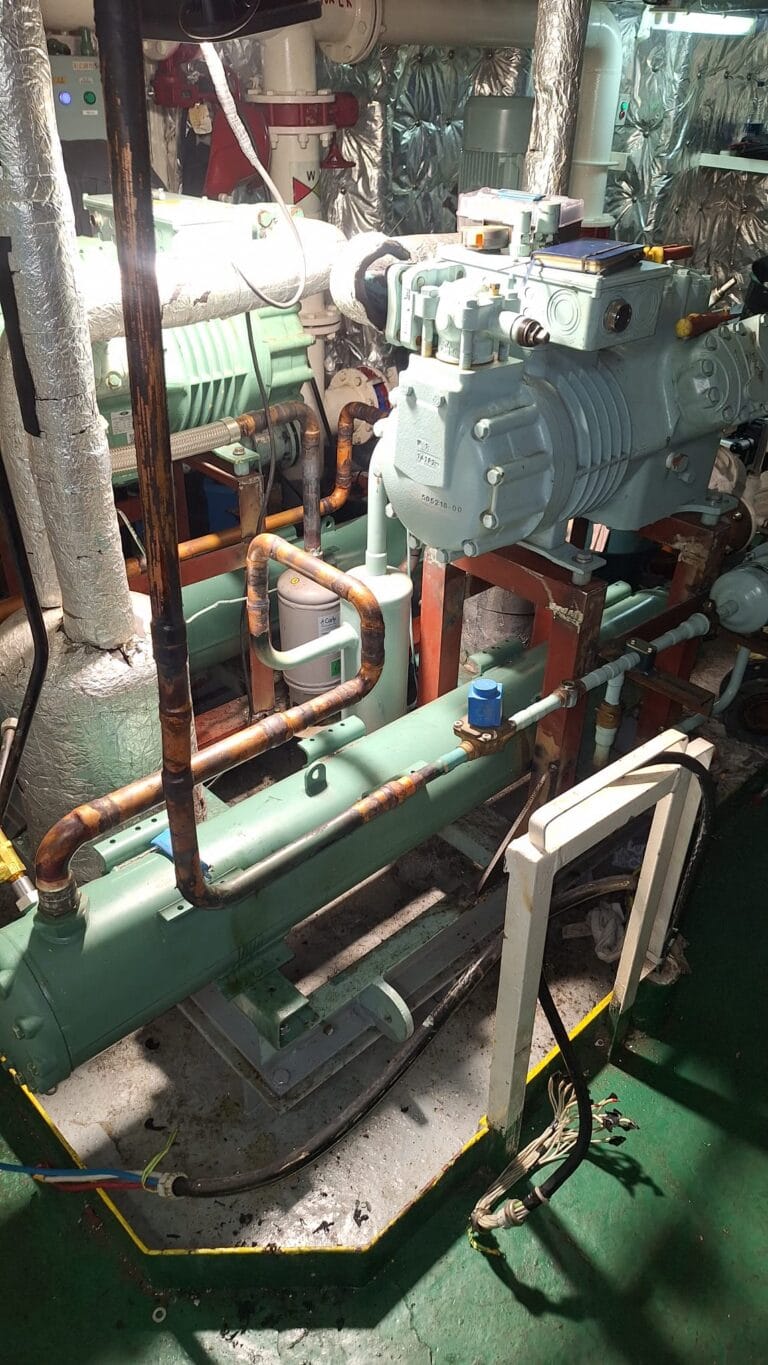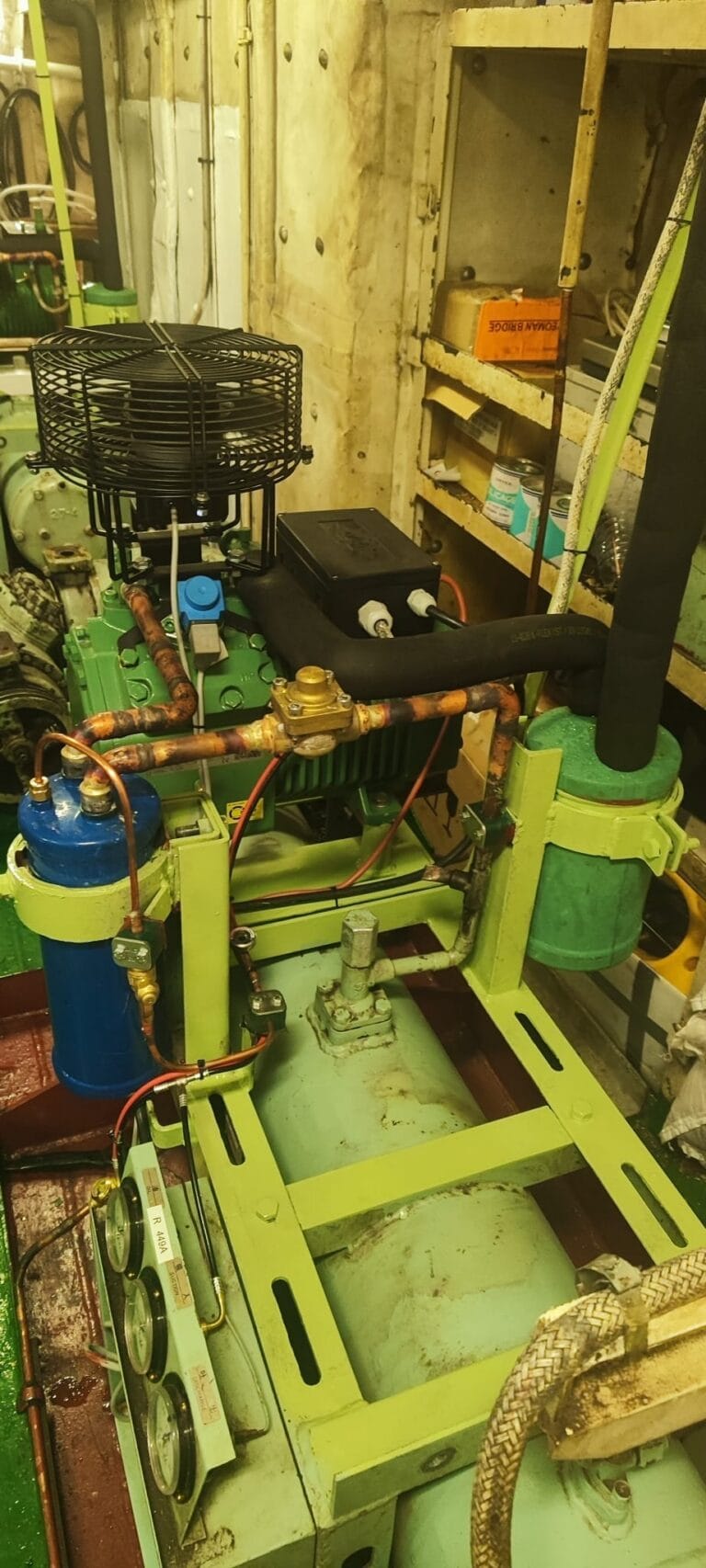
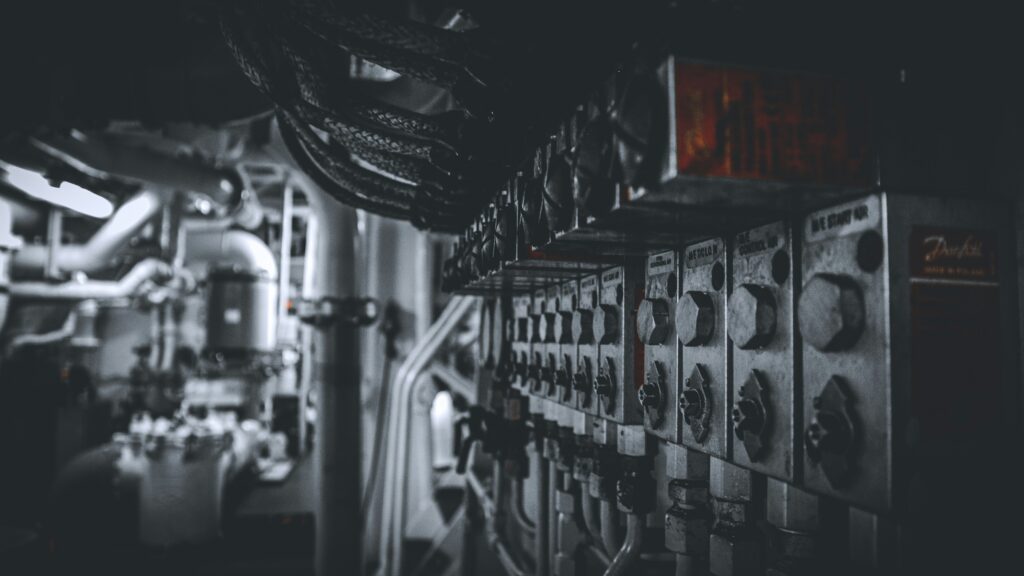
Provision Rooms & Freezers for Ships
We build new provision rooms and freezers for ships and refit existing ones: insulation, doors, condensing unit, air coolers and controls with temperature alarms. Newbuilds, dry dock and port work.
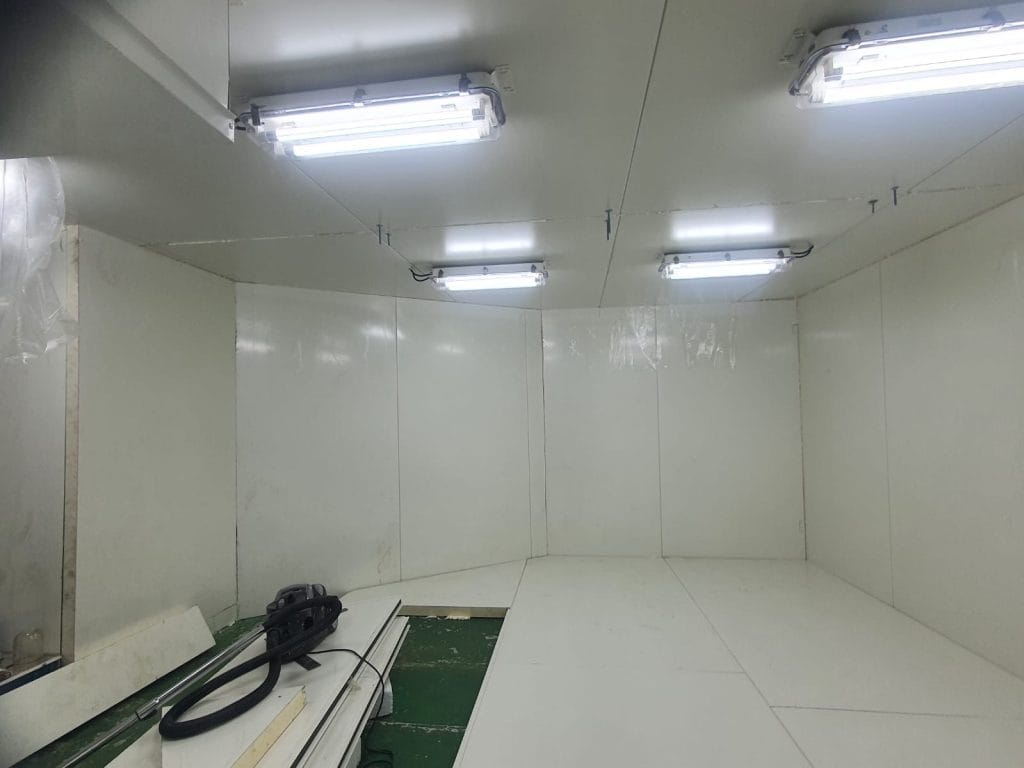
We build provision rooms, freezers and the provision plant that serves them, both on newbuilds and as refits on vessels in service, in dry dock or alongside in port. The scope covers everything from insulation and doors to the condensing unit, air coolers, piping and controls. We work in the ports and shipyards of Gdynia, Gdansk and Szczecin, and travel to ports and yards abroad at the owner’s request, for example Rotterdam, Hamburg and Bremerhaven.
What a ship’s provision plant includes
Provision stores are a set of rooms held at different temperatures, normally served by a single provision plant. A typical layout:
- meat room and fish room: around -20°C,
- vegetable room and dairy room: +2 to +4°C,
- lobby: a chilled buffer in front of the freezers that limits the warm air entering each time a door opens,
- an unrefrigerated dry provision store next to them.
Each room has its own air cooler with a solenoid valve and an expansion valve, so room temperatures are controlled independently. Freezer air coolers have electric defrost, and the drip tray drain is heated and insulated: without that, water freezes in the drain line and ice builds up under the cooler. The plant itself is usually two compressors in duty/standby with a seawater-cooled condenser, so if one compressor fails, the other holds temperatures until it is repaired.
Marine vs. shore-side cold rooms
An insulated panel room looks much the same ashore, but conditions on board decide the materials and equipment:
- Power supply and ambient temperature. Equipment runs on ship’s power, often 440 V / 60 Hz, and must keep its capacity at +45°C in the engine room and with +32°C seawater. These are the design conditions classification societies use for ships in unrestricted service.
- Motion and vibration. The condensing unit, air coolers and piping are mounted so that rolling and hull vibration do not crack joints. Copper joints are brazed.
- Room geometry. Provision stores fit wherever the hull leaves space: sloping walls, frames, pipe and cable penetrations. Panels are cut to fit on site, and every penetration through the insulation is sealed to avoid thermal bridges.
- Hygiene and loads. High-density panels withstand moisture, salt and frequent washing with cleaning agents. Floors are non-slip and take trolleys loaded with crates.
- Crew safety. Doors open from the inside, freezer door frames are heated so gaskets do not freeze to the frame, and each room has a man-trapped alarm button.
New provision rooms or a refit?
On a newbuild we build the provision stores from scratch to the yard’s drawings and outfitting schedule. On a vessel in service, a full rebuild is usually done during a dry dock period, while smaller jobs such as replacing air coolers, doors or controls can also be done alongside in port.
A refit makes more sense than another repair when:
- ice keeps building up on the freezer walls, ceiling or floor and the panels are wet or deformed: the insulation has failed and the plant runs non-stop,
- ice grows under an air cooler because the drain freezes or defrost does not work,
- doors freeze shut and the gaskets and frames are worn out,
- refrigerant has to be topped up regularly because the system leaks in many places,
- the plant still runs on R22 or R404A and refrigerant and spare parts are getting hard to source. In that case we compare a rebuild with an R404A or R22 retrofit.
If the provision plant has stopped cooling at sea or in port, that is a job for our service engineers rather than a refit: see marine refrigeration repair.
Equipment and refrigerants
We size the plant from a heat load calculation for each room: heat gain through the insulation, door openings and stores being loaded. An oversized plant short-cycles and wears faster; an undersized one cannot pull the rooms down after taking on stores. We install Bitzer compressors and Danfoss and Carel controls. The controller monitors every room and raises an alarm when a temperature goes out of range. More on this in marine refrigeration controls.
For new installations we choose a refrigerant with a lower GWP than R404A, for example R449A or R448A. R404A is being phased down in the EU under the F-gas Regulation (EU) 2024/573, so it is becoming more expensive and harder to source. The charged quantity is recorded in the commissioning report, and leak checks and records are covered by our marine F-gas compliance service.
Regulations and inspections
The Maritime Labour Convention (MLC 2006, Regulation 3.2 and Standard A3.2) requires frequent documented inspections, by or under the authority of the master, of food supplies and of all spaces and equipment used to store them. Port State Control inspectors look at the same spaces. A warm freezer, ice on the floor or a door that does not close properly ends up as a deficiency, and serious ones must be rectified before the ship sails.
After installation every system is pressure tested and evacuated, and the owner receives our work report with the test results and commissioning parameters. Since September 2026 our quality management system has been certified to ISO 9001:2015, covering the design, installation and service of refrigeration systems, including on ships.
How a provision plant project runs
- Enquiry. Vessel name or IMO number, port or shipyard, dates of the stay, number of rooms and required temperatures, and if possible photos of the rooms and the plant’s nameplates.
- Survey and heat load. We check the insulation, doors and plant on board (on a newbuild: the yard’s drawings) and calculate the cooling demand. When a full design package is needed, we prepare it as part of our ship refrigeration engineering service.
- Quote and schedule fitted to the vessel’s stay: what can be done alongside and what needs the dry dock.
- Installation. Strip-out of the old fittings, panels and doors, condensing unit, air coolers, piping, cabling and controls.
- Testing and commissioning. Nitrogen pressure test, deep vacuum, refrigerant charge, pull-down and setpoint adjustment.
- Handover. Our work report with the test results, the charged refrigerant quantity and controller setpoints, for the vessel’s records.
Duration depends on the number of rooms and the scope. We confirm it in the quote after the survey and plan the work to fit within the vessel’s stay.
Example: provision plant modernization in dry dock
During a scheduled dry dock stay of a commercial vessel, we relocated the air coolers in the meat and fish rooms and made new silver-brazed pipe connections. In the same stay we replaced the accommodation air conditioning condensers and compressors. Before charging, the systems passed a 24-hour dry nitrogen pressure test and evacuation to 500 microns. Full details in the case study: marine provision plant modernization.
Request a quote
Planning a dry dock, or is your provision plant no longer holding temperature? Send an enquiry with the vessel details and dates, or call our office: +48 574 266 001.