
Marine F-Gas Audits & Compliance
We check the tightness and performance of ship refrigeration and air conditioning, keep a service history for each vessel and provide refrigerant data, including for the ODS Record Book for R22.
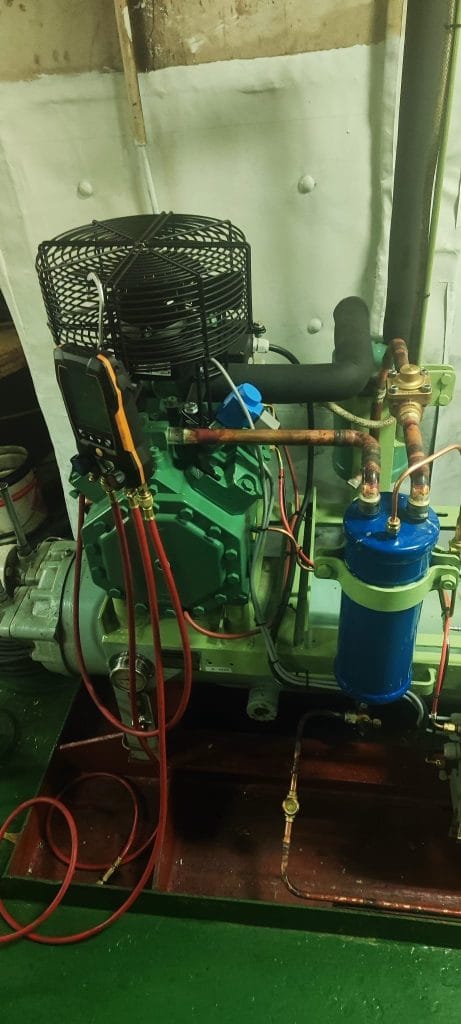
Marine F-gas compliance starts with tight systems and good refrigerant records. In a marine F-gas audit we check the tightness and performance of ship refrigeration and air conditioning plants, keep a service history for each vessel and advise which systems are worth converting to a new refrigerant. We carry out checks wherever the ship is: in Gdynia, Gdansk and Szczecin, in ports across Europe and at sea.
What a marine F-gas audit covers
- System inventory: which plants are on board, which refrigerant they use and how much, based on nameplates and documentation.
- Leak check: pressures on the service gauges show whether the system holds the right charge. If something does not add up, we locate the leak with an electronic leak detector.
- Performance check: operating pressures and temperatures, superheat and subcooling, compressor and condenser operation.
- Recommendations: what to fix now, what at the next port call or docking, and which systems to convert to a new refrigerant.
- Service report with the findings, the quantity of refrigerant added or recovered, and recommendations. We keep a service history for each vessel, so at the next visit you can see how the plant is changing.
What applies on board: R22, HFCs and the rules
- R22 and other ozone-depleting substances are covered by MARPOL Annex VI, Regulation 12: deliberate emissions are prohibited, new installations containing HCFCs have been prohibited since 2020, and every recharge, repair and recovery is entered in the Ozone-depleting Substances Record Book. Equipment containing ODS is listed in the supplement to the IAPP certificate, and the record book can be checked by Port State Control. After every job we provide the refrigerant quantities for this record book.
- HFC refrigerants such as R404A, R134a or R407C are covered in the EU by Regulation (EU) 2024/573. How it applies to equipment on ships depends on interpretation: the Netherlands Shipping Inspectorate, for example, considers that the operator must prevent leaks and repair them without undue delay, but that the regulation’s periodic leak check requirements do not apply to ships. That is why we agree the scope and frequency of checks with the owner, and it is worth asking the flag administration if in doubt.
- Refrigerant availability: since 2025, virgin refrigerants with a GWP of 2500 or more (such as R404A) may not be used to service refrigeration equipment in the EU, and HFC quotas keep shrinking. Every leak of such a refrigerant becomes a supply problem in a European port.
What a leak means in CO2 terms
The climate impact of a refrigerant is measured in tonnes of CO2 equivalent: the charge in kilograms multiplied by its GWP. For R404A (GWP 3922), 10 kg is about 39 tonnes of CO2; for R134a (GWP 1430), about 14 tonnes. In the EU, obligations for equipment ashore depend on this figure, and on board it is a good guide to which systems to check most often and which to convert first to a lower-GWP refrigerant.
Why check for leaks even when nobody requires it
A leak costs more than the refrigerant. A system that is short of charge loses capacity, the compressor runs longer and hotter, and oil return suffers, which shortens its life. In a provision plant this ends with a warm freezer room; on air conditioning, with a stuffy superstructure in the tropics. A leak found early is fixed in a few hours; one found late often ends in a compressor overhaul.
Where ships most often leak
- flare and threaded joints that hull vibration loosens over time,
- shaft seals on open-type compressors such as Sabroe,
- service valves, caps and sight glasses,
- pressure switches and capillary tubes that crack from vibration,
- seawater-cooled shell-and-tube condensers, where corroded tubes let refrigerant escape into the water,
- piping on the open deck, where salt speeds up corrosion.
When the audit finds a problem
We repair leaks and faults on the spot or at the next port call: see marine refrigeration repair. If a system runs on R22 or R404A and keeps leaking, converting it to a new refrigerant usually pays off: see marine refrigerant retrofit.
Qualifications
The company holds an F-gas certificate (no13KFCH), and every technician holds a personal F-gas certificate (covering leak checks, refrigerant recovery, repair and servicing of F-gas systems) and Polish SEP electrical qualifications. Since September 2026 our quality management system has been certified to ISO 9001:2015.
How to prepare for a marine F-gas audit
- a list of systems with refrigerants and charges, if the ship has one,
- the latest service reports and records of refrigerant top-ups,
- the ODS Record Book, if the ship still runs on R22,
- access to the engine room and the equipment, and contact details for the engineer who knows the installation,
- a time slot when the systems can run under observation or be shut down briefly.
Book a marine F-gas audit
Send us the vessel name or IMO number, the port and dates of the stay, a list of systems with refrigerants (if you have one) and the latest service reports. Send an enquiry or call the number in the page header.