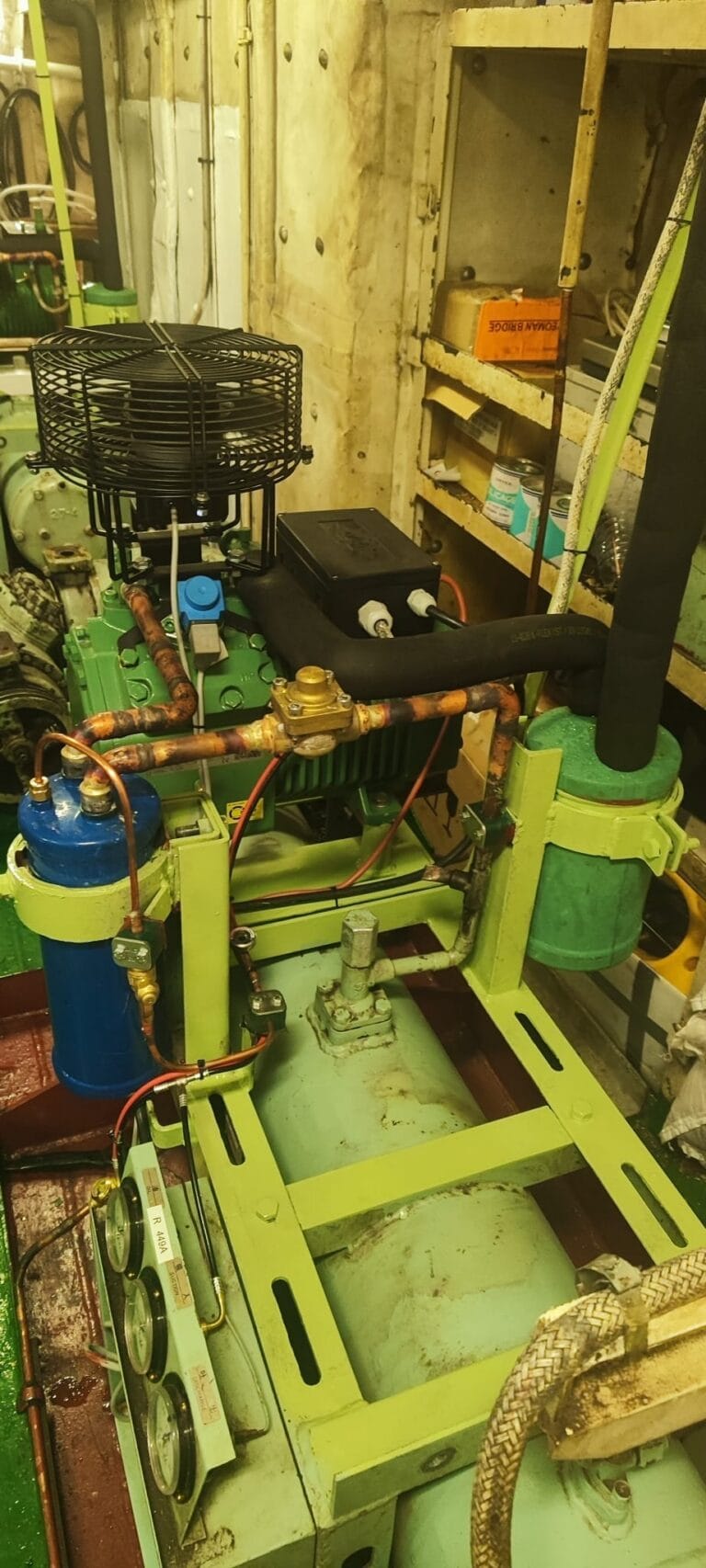

R22 & R404A Conversions and Retrofits
We convert ship refrigeration and air conditioning from R22 and R404A to approved replacements. A typical retrofit takes 1–2 days per system, alongside, in a shipyard or at sea.
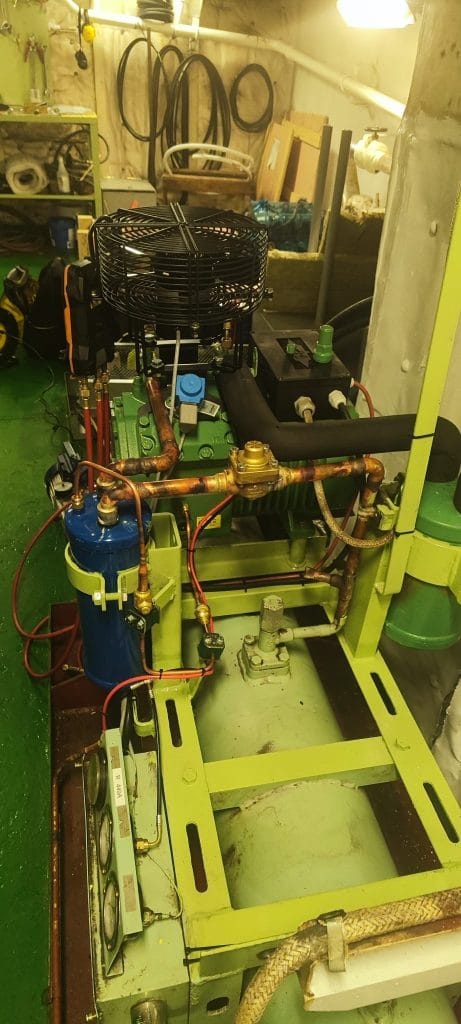
Marine refrigerant retrofit is where Cold World started in 2014. We convert ship refrigeration and air conditioning plants from refrigerants that can no longer be used or bought, such as R22 and R404A, to approved replacements. A typical retrofit takes 1–2 days per system, alongside in port, in a shipyard or at sea.
Is R404A being phased out? Why R22 and R404A have to go
- R22 is an ozone-depleting HCFC. Under MARPOL Annex VI, Regulation 12, new installations containing HCFCs have been prohibited on ships since 1 January 2020, deliberate emissions are prohibited, and every recharge, repair and recovery must be entered in the Ozone-depleting Substances Record Book. In the EU, R22 may no longer be used to service equipment (since 2015).
- R404A has a very high GWP of 3922. Since 1 January 2025, the EU F-gas Regulation (EU) 2024/573 has prohibited virgin refrigerants with a GWP of 2500 or more for servicing refrigeration equipment; reclaimed or recycled gas is allowed until 2030. With the EU HFC phase-down, R404A is also getting more expensive and harder to source.
Whatever the flag, R22 and R404A are getting hard to find in European ports, so every leak on such a plant turns into a refrigerant supply problem.
What can replace R404A and R22?
We choose the replacement for the operating temperature, the compressor and the condition of the plant. The options we use most often:
| Refrigerant | Replaces | GWP | Typical use |
|---|---|---|---|
| R449A | R404A, R22 | 1397 | provision rooms and freezers |
| R448A | R404A, R22 | 1387 | provision rooms and freezers |
| R407F | R404A, R22 | 1825 | provision rooms, medium-temperature plants |
| R407C | R22 | 1774 | air conditioning |
| R513A | R134a | 631 | air conditioning and chillers |
GWP values follow the IPCC Fourth Assessment Report (AR4). All of these refrigerants are safety class A1 (non-flammable, low toxicity), which matters on board. R449A, R448A and R407F are blends with temperature glide, so the superheat has to be reset after the retrofit and an expansion valve is sometimes replaced. R134a is not a replacement for R404A in freezers, as it loses too much capacity at low evaporating temperatures, and R410A cannot go into an R22 system, because it runs at much higher pressures. We also replace R422D, a former drop-in for R22, whose GWP of 2729 now puts it on the list as well.
R404A retrofit: drop-in or full conversion?
Even replacements sold as “drop-in” usually need at least new filter-driers, an oil check and new settings, and sometimes that is all it takes. Often, though, once the system is opened, the compressor, valves or heat exchangers turn out to need work, and the retrofit becomes an upgrade. That is why we assess the plant on board before quoting.
When the compressor is too old or not suitable for the new refrigerant, we replace it and match the plant to the replacement. More on this in marine compressor overhauls.
How a marine refrigerant retrofit runs
- Assessment: compressor (make, model, oil), expansion valves, filters, tightness, refrigerant charge and operating data.
- Choice of replacement for the operating temperature and the compressor, taking the capacity after conversion into account.
- Recovery of the old refrigerant into cylinders, with nothing vented to atmosphere.
- Oil and components: oil change (usually to polyolester POE for HFC and HFO blends), new filter-driers and seals, and expansion valves where needed.
- Tests: nitrogen pressure test and evacuation to a deep vacuum.
- Charging and start-up: new refrigerant, superheat and controller settings, and a check of room temperatures. Older controllers can be upgraded as part of our marine refrigeration controls service.
- Documents: our work report and service report, with the quantities of refrigerant recovered and charged.
Alongside, in the yard or at sea
A retrofit usually takes 1–2 days per system, depending on its size and condition. We do it during a port call or a yard stay, and when the ship cannot wait, our engineer sails with her and converts the plants at sea. We work most often in Gdynia, Gdansk and Szczecin, and travel to ports across Europe, including Rotterdam, Hamburg and Bremerhaven.
Example: R449A conversion at sea
On a cargo vessel we converted both provision plant circuits to R449A with no yard stay. New Bitzer semi-hermetic compressors replaced worn Daikin units, and the plant received oil separators, new Danfoss controls and expansion valves selected for R449A. On the air conditioning we recovered R422D and changed the oil to synthetic. After a nitrogen test and evacuation to 500 microns, the provision rooms ran steadily at an evaporating temperature of -27°C. Full details: in-transit R449A retrofit case study.
Qualifications
The company holds an F-gas certificate (no13KFCH), every technician holds a personal F-gas certificate and Polish SEP electrical qualifications, and since September 2026 our quality management system has been certified to ISO 9001:2015. If you first want to know which plants on board need a retrofit, start with a check under our marine F-gas compliance service.
Request a retrofit quote
Send us the vessel name or IMO number, the port and dates of the stay, the refrigerant and the number of circuits, and if possible a photo of the compressor nameplate. Send an enquiry or call the number in the page header.