Marine Refrigeration Controls & Automation
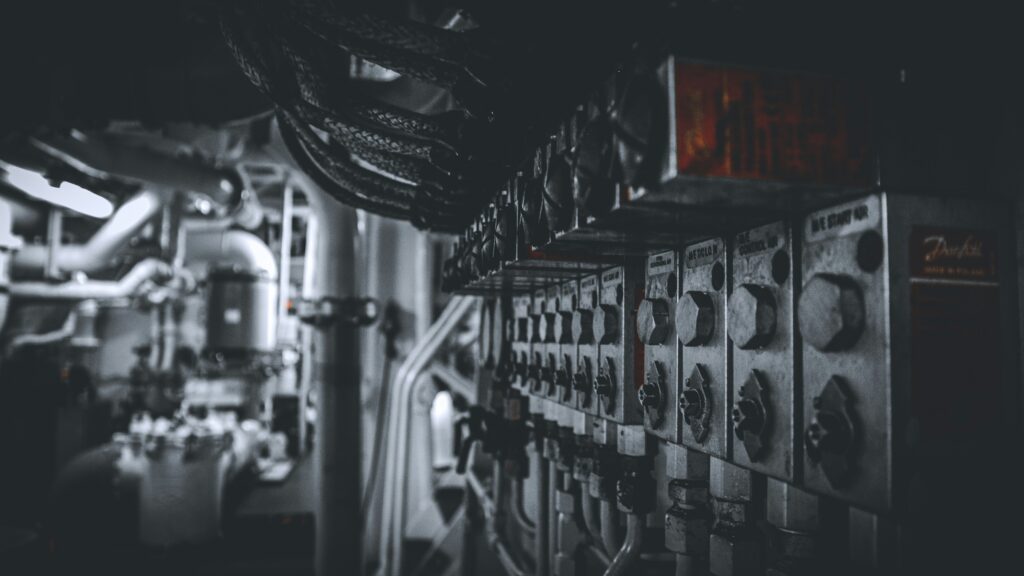
We repair and upgrade refrigeration and air conditioning controls on ships: Danfoss and Carel controllers, control panels, expansion valves, safety devices and alarms.

Marine refrigeration controls decide whether provision rooms and air conditioning hold their temperatures and whether an alarm goes off in time. We repair and upgrade the controls of ship refrigeration and air conditioning plants: we replace worn-out controllers with Danfoss and Carel, rebuild control panels, tune expansion valves and test the safety devices.
What marine refrigeration controls do
- Room and plant controllers: hold the temperature in each room and run the compressors, defrost and fans.
- Compressor protection: high and low pressure switches, oil pressure monitoring, motor protection, phase sequence and phase failure protection.
- Valves: solenoid valves that shut off each room, and thermostatic or electronic expansion valves.
- Defrost: air cooler and drain heaters, with defrost terminated by temperature or time.
- Alarms: room temperature out of range, safety device trips, compressor failure.
- Control panels: power supply, contactors, protection devices and the wiring that ties it all together.
Common control faults
Many failures that look like a compressor problem start in the controls. The ones we see most often:
- failed temperature sensors and pressure transmitters: the controller sees the wrong value and stops the compressor for no reason, or never stops it,
- false alarms, until the crew stops reacting to them,
- defrost that never ends or never starts: the air cooler ices up and the room warms up,
- burnt contactor tips and loose connections in a panel exposed to vibration and humidity,
- an obsolete controller with no spare parts, so every failure risks a long outage,
- wrong superheat settings after a refrigerant or expansion valve change.
If the compressor itself has failed rather than its controls, see marine compressor overhauls.
Repair or replace the controls?
A single sensor or contactor we fix on the spot. Replacing the controls is worth considering when:
- spare parts for the controller are no longer available, or it needs software nobody has,
- control failures keep coming back and each repair takes longer,
- the panel wiring is damaged, modified many times and has no up-to-date diagram,
- after a refrigerant retrofit the old settings and valves no longer suit the plant,
- the crew no longer trusts the alarms because too many are false.
Control panels on board
A panel in the engine room works with vibration, humidity and salt, so when rebuilding one we look at things you rarely see ashore: re-tightening terminals that vibration loosens over time, a well-sealed enclosure protected against internal condensation, clearly labelled wires, and an up-to-date diagram left on board. Ship’s power (often 440 V / 60 Hz) can be less stable than a shore grid, so phase failure and phase sequence protection matter.
Upgrading refrigeration controls
- Survey: condition of the panel and wiring, the diagram, controllers, sensors and safety devices, and the alarm list.
- Selection of new controllers from Danfoss or Carel, with spare parts available in port.
- Panel: a rebuild of the existing one or a new control panel; when needed, our electrician builds it in our workshop in Rumia, Poland.
- Installation and wiring of sensors, pressure switches, valves and fans.
- Settings: temperature, defrost, delay and alarm setpoints.
- Safety device test: we check at which values they actually stop the compressor.
- Handover: our work report with the list of settings, so the crew knows what is set and where.
Electronic expansion valves
We replace and tune electronic expansion valves. They hold superheat more precisely than thermostatic valves, also when the load changes, for example after stores are loaded. They work well after a marine refrigerant retrofit to blends with temperature glide such as R449A or R448A, where the superheat setting matters.
Examples from our projects
- Accommodation AC rebuild: a new electrical cabinet, a Danfoss pressure switch for high-pressure protection and another for capacity and condenser fan control, solenoid valves and new expansion valves. We checked the high-pressure cut-out at 22 bar. See the accommodation AC rebuild case study.
- Retrofit at sea: new Danfoss controls and a dedicated control panel for the provision plant, with expansion valves selected for R449A. See the in-transit R449A retrofit case study.
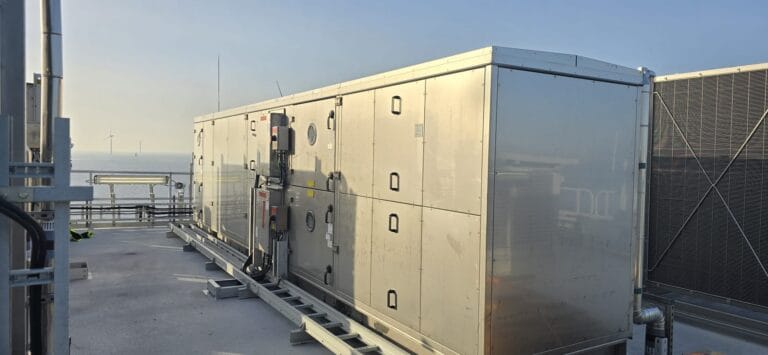
- Offshore wind farm: during HVAC commissioning we checked the pressure switches and phase failure protection, and the control logic of the split units. See the offshore HVAC commissioning case study.
Qualifications
Every technician holds Polish SEP electrical qualifications and a personal F-gas certificate, and the company holds an F-gas certificate (no13KFCH). Since September 2026 our quality management system has been certified to ISO 9001:2015.
Report a control problem
Send us a photo of the panel and the controller nameplate, the alarm codes, a description of the symptoms and the vessel details (name or IMO number, port, dates of the stay). Send the details or call the number in the page header.