Marine HVAC Design & Refrigeration Engineering
We design ship refrigeration, air conditioning and ventilation: from heat load calculations and equipment selection to the layout in the engine room. Our engineer designs it, our crews install it.
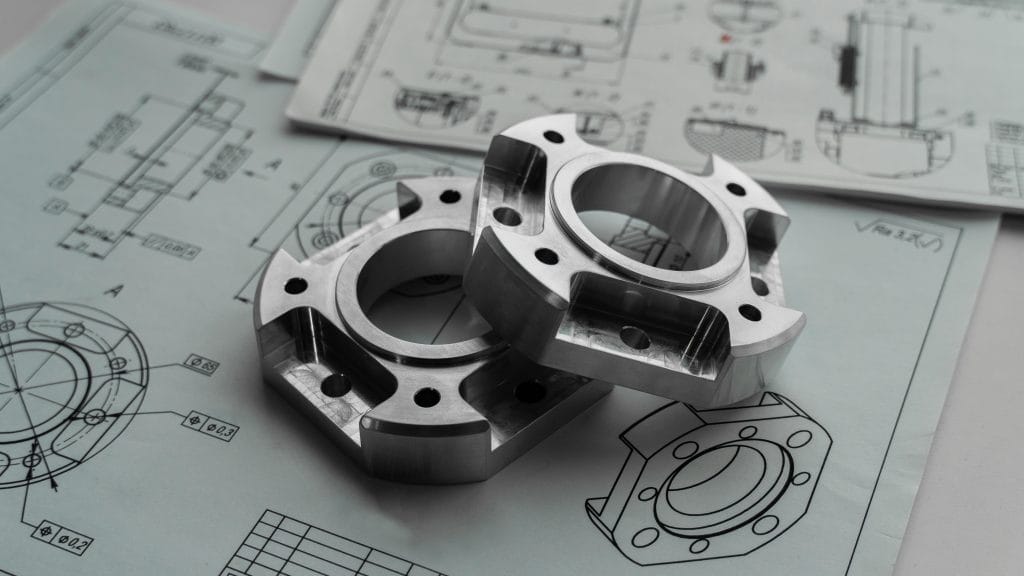
Marine HVAC design and refrigeration engineering are done in-house at Cold World: our engineer prepares the design and our own crews install it. We design new installations and conversions of existing ones, from provision plants to accommodation air conditioning, ventilation and cargo hold cooling.
What we design
- Provision rooms and freezers: heat load of each room, selection of the condensing unit, air coolers and controls. More on the rooms themselves in provision plant and provision rooms.
- Air conditioning: air handling units and condensing units for cabins, mess rooms, the control room, galley and workshops.
- Ventilation: engine room, cargo holds and technical spaces. In the engine room, ventilation supplies air to the engines and removes heat from machinery; in cargo holds it removes moisture so that condensation does not form on the cargo.
- Cargo hold cooling for cargo that needs a stable temperature, from the heat load and plant selection to cold air distribution.
- Conversions: recalculating an existing installation for a new refrigerant or a higher load, for example in a marine refrigerant retrofit.
How marine HVAC design works
- Input data: vessel type and trading area, room drawings, number of crew, required temperatures and power supply, and for a conversion, data on the existing installation.
- Concept: heat load calculation, choice of system (for example one plant for all rooms or separate ones), preliminary equipment selection and layout in the available space.
- Design: selection of compressors, condensers, air coolers and air handling units, pipe sizes, controls and safety devices.
- Coordination with the yard or the owner: space for equipment, penetrations through bulkheads and decks, power supply.
- Installation and commissioning by our own crews. See marine HVAC installation.
On a newbuild the design develops together with the yard’s drawings, so the biggest gains come from equipment layout. On a conversion we start by surveying and measuring the existing installation: some piping and equipment can usually stay, and the design shows what has to be replaced.
What goes into the heat load calculation
The heat load calculation is the basis for selecting equipment. For provision rooms we calculate heat gains through the insulation, from door openings and from stores being loaded. For air conditioning we add:
- solar gain on the superstructure and outer walls,
- heat from people, lighting and equipment, especially in the galley and in a control room full of electronics,
- fresh air that has to be cooled and dehumidified,
- humidity: in the tropics, dehumidification loads the plant more than cooling alone.
The calculation gives the plant capacity, and it also shows whether the equipment will fit in the available space and whether the ship’s power supply can carry it.
Design mistakes we see in service
Some of the breakdowns we travel to start in the design. The most common ones are:
- a condenser sized for cold waters, which cannot keep up in the tropics and trips the compressor on high pressure,
- an oversized plant that short-cycles and wears out faster,
- a single compressor with no standby, so one failure means losing cooling,
- equipment built in so that valves and filters cannot be reached without dismantling,
- a refrigerant that can no longer be bought in European ports.
We avoid these from the start, because we service the installations we design.
Design conditions on board
A marine installation has to keep its capacity where the ship actually trades: at up to +45°C in the engine room and with seawater up to +32°C, the conditions classification societies use for ships in unrestricted service. Air conditioning of accommodation spaces is usually calculated to ISO 7547, which sets out the design conditions and calculation methods for ships.
On top of that come ship’s power (often 440 V / 60 Hz), hull vibration and rolling, and a cramped engine room in which every unit has to be accessible for service and replacement. We choose refrigerants that can be bought in port: new installations are designed for lower-GWP refrigerants such as R449A, R448A, R407F or R513A.
Example: accommodation air conditioning rebuild
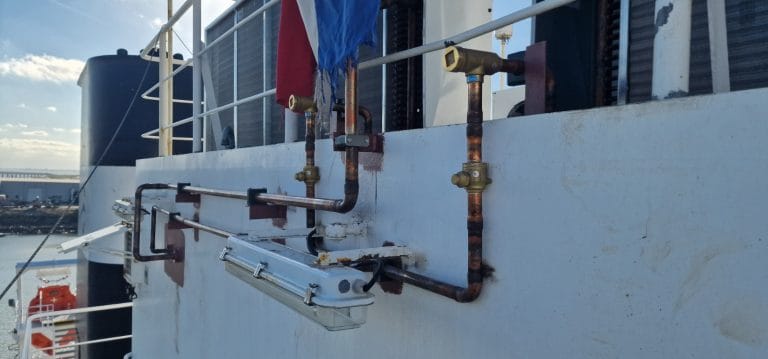
On a cargo vessel we replaced the main air handling units for the port and starboard sides during a port stay, without stopping cargo operations. Each side received a new Frascold compressor on a new foundation, with an oil separator, a suction accumulator and two air-cooled condensers. Pipe penetrations through the hull were sealed with Roxtec, and the installation got a new electrical cabinet. Full details in the accommodation AC rebuild case study.
Design, installation and service in one place
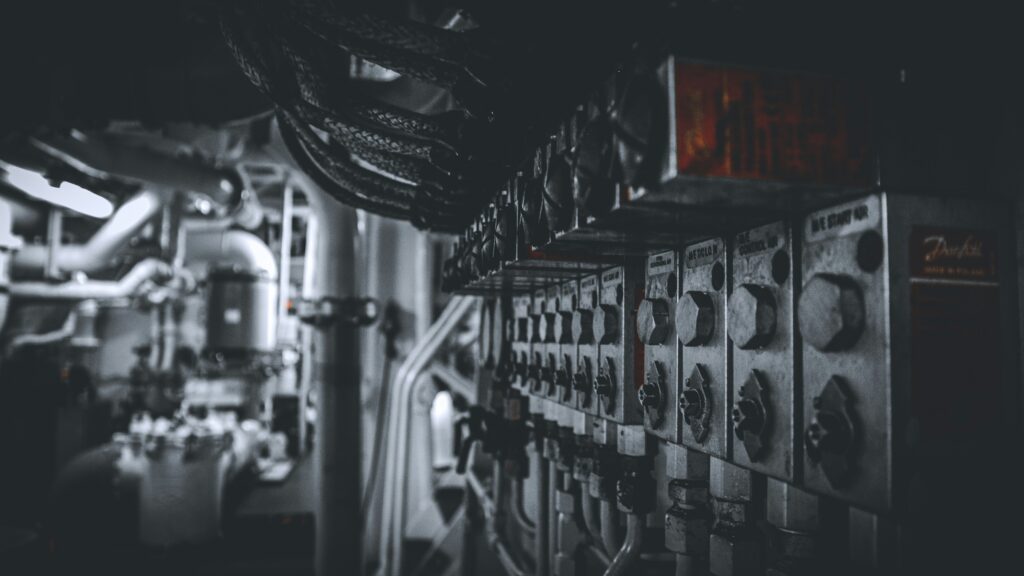
We install, commission and service the installations we design, so access for service and parts that can be sourced in port are part of the design from day one. Controls are selected together with the installation (more in marine refrigeration controls). Since September 2026 our quality management system has been certified to ISO 9001:2015, covering the design, installation and service of refrigeration, ventilation and air conditioning systems, including on ships.
Request a design quote
Send us the vessel type or IMO number, the scope (provision rooms, air conditioning, ventilation, cargo holds), drawings or photos of the spaces and the planned dates. Send an enquiry or call the number in the page header.